
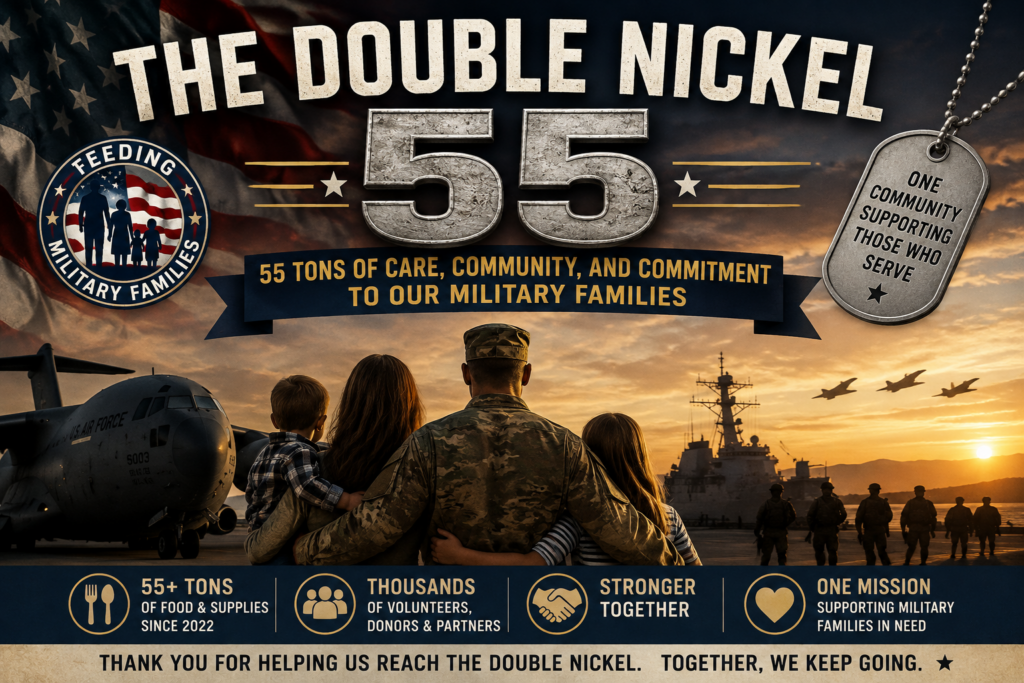
There are milestones that measure progress, and then there are milestones that tell a story. For Feeding Military Families, 55 tons is one of those milestones.
With more than eight tons of food and supplies collected during our August 15, 2026 food drive, Feeding Military Families crossed the “Double Nickel”—more than 55 tons collected since this community effort began in 2022. That is more than 110,000 pounds of food and supplies gathered, sorted, packed, palletized, loaded, transported, and placed into a system designed to help military families who need a little assistance.
But the number itself is only part of the story. The real story is how we got there.
It Was Never the Work of One Organization
Feeding Military Families has grown because people and organizations throughout our communities have decided that supporting military families is something worth doing together.
At the center of the effort is the Satellite Rotary Club of Military Family Support, working with fellow Rotarians and community partners to turn concern about military food insecurity into action. The Rotary Club of San Dimas has been an important part of that effort, providing volunteers, financial support, visibility, and the kind of hands-on service that Rotary does best.
But this has never been a Rotary-only project. The San Dimas Masonic Lodge and the larger Masonic family have become important partners, providing volunteers and a place where much of the work happens. Members help receive donations, sort supplies, prepare pallets, load vehicles, and perform the countless jobs necessary to turn thousands of individual donations into organized shipments ready for military communities.
The extended Masonic family has contributed in ways large and small. Carol Gill, a Masonic widow, is one wonderful example. Over the years, she has made hundreds of beautiful handmade quilts for families, transforming fabric, time, and individual effort into something personal that can accompany the food and other necessities we provide.
The next generations are getting involved as well. Children and grandchildren of Masons, Senior DeMolays, and Job’s Daughters have worked inside the Lodge alongside longtime volunteers. At the August drive, the 8- and 10-year-old granddaughters of a Senior DeMolay and a Job’s Daughter helped unload an early delivery of food and supplies.
It was a simple scene, but it represented something much larger: the values of service being passed from one generation to another.
The Community Shows Up
The Double Nickel was possible because the community showed up—and continues to show up.
Organizations such as the Hacienda Heights Women’s Club and the East San Gabriel Valley Republican Club have joined local business owners, service organizations, community groups, and individual residents in collecting and donating food and supplies. Some supporters organize collections, others provide financial assistance, and still others contribute services, transportation, equipment, publicity, sponsorships, or simply the labor needed to move thousands of pounds of supplies.
One of our strongest community partners has been the Holy Name of Mary Stars and Stripes Ministry. Its commitment to veterans, active-duty service members, and military families is among the strongest in the San Dimas community. Its continued involvement in Feeding Military Families reflects a shared belief that supporting those who serve—and the families who serve alongside them—is a responsibility that extends throughout the community.
That partnership is particularly important because Feeding Military Families has never been about placing one organization’s name above another. It is about building a network of people and organizations that recognize a need and are willing to work together to meet it.
Sometimes that means arriving with a truck filled with food. Sometimes it means writing a check or bringing a few bags of groceries. Sometimes it simply means showing up ready to work. Every one of those contributions has helped move us toward 55 tons.
Families Serving Families
Perhaps one of the most encouraging developments has been the number of young people and entire families who now volunteer together. Parents bring their children, grandparents bring their grandchildren, and young people work alongside Rotarians, Masons, veterans, business owners, and longtime community volunteers.
Entire families have spent hours sorting donations, filling boxes, packaging food, moving supplies, and preparing pallets together. That changes the nature of the project because Feeding Military Families becomes more than a place where people donate food; it becomes a place where families teach service by practicing it together.
A young person packing a box may not understand military compensation, food insecurity statistics, or the financial pressures facing a junior enlisted family. But that young person can understand that another family needs help and that his or her own family chose to show up and do something about it.
That is how service becomes a value rather than simply an activity.
How a Bag Becomes 55 Tons
No single contribution creates 55 tons. Thousands of contributions do, and that may be one of the most important lessons Feeding Military Families has taught us.
Community service does not require everyone to make an enormous contribution. One person brings a bag of groceries. A family brings several boxes. A club conducts a collection. A business provides a sponsorship. A church ministry mobilizes its members. Volunteers sort and package everything, someone provides transportation, and someone else spreads the word.
Those individual acts begin to accumulate. Bags become boxes, boxes become pallets, and pallets become truckloads. Over four years, those truckloads have become more than 55 tons.
That is the Double Nickel.
Where It Goes Matters
Feeding Military Families does not simply hand bags of groceries directly to individual families. We work through military food pantries and military family support organizations that know their communities, understand the needs of their families, and are positioned to get assistance where it can do the most good.
Over the years, our efforts have reached military communities throughout Southern California, including installations representing every branch of the United States Armed Forces.
That matters because food insecurity in the military is real, and much of it remains largely invisible to the civilian community. Research has documented significant levels of food insecurity among active-duty personnel while also identifying barriers that can prevent military families from seeking assistance. Those barriers include eligibility requirements, lack of knowledge about available resources, difficulty accessing assistance, and the stigma associated with asking for help.
Research reviewed by Military REACH has also identified particular vulnerabilities among younger and lower-ranking service members and some military families with children. Studies have further found relatively low participation by active-duty personnel in traditional food-assistance programs.
Those realities help explain why community organizations, military food pantries, and family support networks can play such an important role. We are not replacing the military’s support systems or government assistance programs; we are strengthening the network of resources available to military families.
More Than Food
Although we call it Feeding Military Families, the mission has never been limited to canned goods. Over the years, our community has responded with hygiene products, diapers and baby supplies, household necessities, handmade quilts, toys and holiday gifts, and direct financial support.
Thousands of toys have helped make Christmas brighter, while tens of thousands of dollars in support have allowed us to respond to needs that cannot be met with a box of groceries. Carol Gill’s hundreds of handmade quilts are another reminder that some of the most meaningful contributions cannot be measured simply by weight.
Together, these efforts carry a message beyond the material value of what is being provided: You serve our country, your family serves alongside you, and your community has not forgotten you.
Rotary at Its Best
There is a reason this project fits so naturally within Rotary. “Service Above Self” is easy to put on a banner; its meaning becomes much clearer when people are moving boxes, packing food, loading pallets, writing checks, making telephone calls, collecting donations, or bringing their children and grandchildren along to volunteer.
Feeding Military Families also demonstrates something larger about community service. Rotarians work beside Masons. Church ministries work beside service organizations. Business owners work beside community volunteers. Grandparents work beside grandchildren. People representing different organizations, professions, backgrounds, and generations find themselves standing around the same tables packaging food for military families they may never meet.
Holy Name of Mary’s Stars and Stripes Ministry has demonstrated that spirit repeatedly through its commitment to veterans and military families. The San Dimas Masonic Lodge has demonstrated it. The Hacienda Heights Women’s Club and East San Gabriel Valley Republican Club have demonstrated it. Local businesses, individual donors, volunteers, families, and young people have demonstrated it.
No one organization reached the Double Nickel. A community did.
The Double Nickel Is Not the Finish Line
We should celebrate 55 tons, but we should celebrate the people behind it even more: every volunteer who lifted a box, every donor who contributed a dollar, every organization that conducted a collection, every business that supported the effort, every young person who packed a bag, and every family that chose to spend part of its day serving another family.
Feeding Military Families began in 2022 with an idea that our community could do something meaningful about a problem most people never see. Four years later, that idea has become more than 110,000 pounds of food and supplies and a growing network of Rotarians, Masons and the extended Masonic family, churches and ministries, service organizations, businesses, volunteers, donors, young people, and entire families who continue to answer when the call goes out.
Our next major food drive will come in March, and the work will begin again. The pallets will need filling, the boxes will need packing, the trucks will need loading, and somewhere in one of our Southern California military communities, a family will need a little help.
We reached the Double Nickel one donor, one family, one volunteer, one organization, and one box at a time. That same community will now begin working toward the next milestone.
Learn more and become part of the effort at www.FeedingMilitaryFamilies.org.


This is such a beautiful article. And the Stars & Stripes Ministry is certainly pourd to be part of this effort, and at the same time we’re humbled by the sacrifice of the men and women who this effort supports.
May God continue to bless our military. May God continue to bless the united States of America.
This is such a beautiful article. And the Stars & Stripes Ministry is certainly pourd to be part of this effort, and at the same time we’re humbled by the sacrifice of the men and women who this effort supports.
May God continue to bless our military members. May God continue to bless the united States of America.